From intent
to action.
By design.
An agentic web platform for continuous development and operations. Built around explicit goals, local intelligence and human direction.
Currently in design. Architecture and API drafts are public.

- 01 /
Explicit by design
Goals, authority and budgets, defined before action.
- 02 /
Local at the core
A planned Rust foundation for browser and Linux.
- 03 /
Human in command
Observe, intervene and decide what comes next.
01 — Architecture
One contract.
A continuous loop.
The goal: connect development, local operation and learning through shared, inspectable definitions.
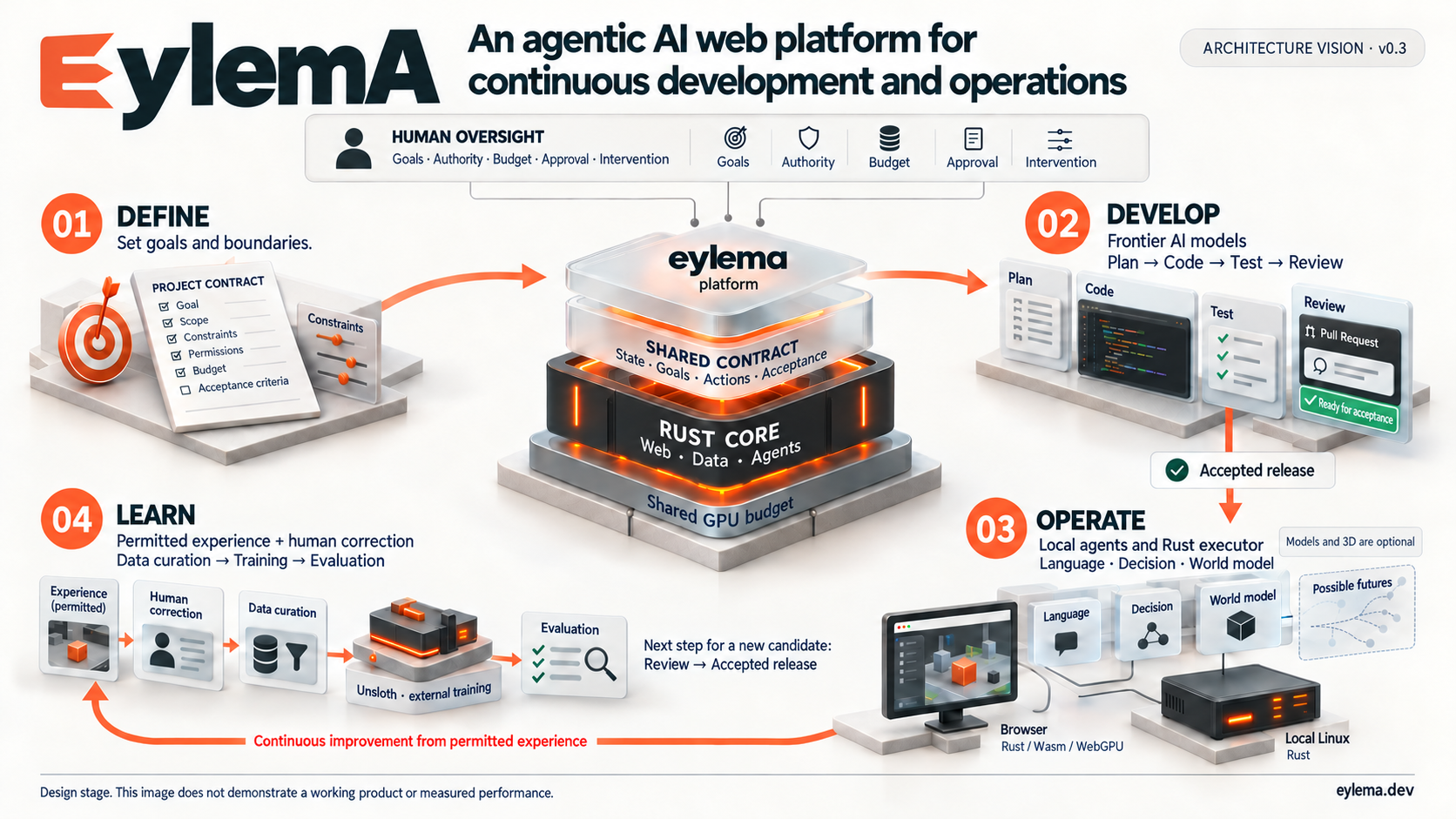
The proposed architecture in one view. Design-stage illustration; not a running product or performance result.
Open full-size image (new tab)Start with intent.
Describe the state, goals, allowed actions, authority and resource budget. Make acceptance explicit before work begins.
Read the architecture- State
- Actions
- Authority
- Budget
Concept illustration · not a running platform
Turn a need into a change.
The proposed AI development team works from a scoped request to a plan, implementation and checked pull request. Independent review and maintainer acceptance remain separate gates.
Read the team protocol- Plan
- Implement
- Verify
- Review
Concept illustration · not a running platform
Act within clear boundaries.
Accepted local agents are intended to propose actions against observed state. The planned Rust executor checks authority, state and budgets before acting, then records the actual outcome.
Read the API contract- Propose
- Validate
- Execute
- Observe
Concept illustration · not a running platform
Let evidence guide improvement.
Permitted experience and human corrections can become curated training data. A candidate must pass independent task and hardware evaluations before a release is accepted.
Read the learning protocol- Curate
- Train
- Evaluate
- Accept
Concept illustration · not a running platform
Human direction, throughout.
Set the goal. Inspect the evidence. Intervene when needed.
02 — Questions & answers
A clear idea.
An honest start.
The essential facts about Eylema, with the original design documents one click away.
What is Eylema?
Eylema is a proposed agentic AI web platform for continuous development and operations. Its design connects explicit application contracts, AI development teams and local agents, with human-defined authority.
Architecture v0.3Can I use Eylema today?
You can explore the public architecture, API and team protocol drafts. There is no released Eylema framework, production API, supported model runtime or published performance benchmark yet. This website introduces the design; it is not a platform demo.
Current project statusWho stays in control?
The design keeps people in command of goals, authority, budgets and delegation. Humans can participate at required approval points, inspect outcomes and request intervention. Models cannot expand their own permissions. These oversight mechanisms still require implementation and testing.
API and human oversightWhere will Eylema run?
The proposed targets are Rust/Wasm in the browser with WebGPU, and native Rust execution on Linux. Browser, operating system, drivers and model artifacts remain explicit dependencies. Device compatibility and combined performance have not yet been validated.
Platform architectureEnglish is canonical. Turkish is a full companion.
03 — The road ahead
Built in the open.
Proven step by step.
Eylema is in the architecture and API design stage. The runtime, model support and performance results are still ahead.
- 01
Define the foundation
Architecture, API contracts and development protocols.
Design drafts - 02
Prove the first application
Rust execution, persistent state and a small browser 3D scene.
Planned - 03
Close the learning loop
Local models, permitted experience and evaluated improvements.
Planned
Help shape what comes next.
Explore the design. Challenge an assumption. Propose a focused change.